2 Carat Lab-Grown Diamond Ring Price: Why One Costs More Than Another

If you have been comparing 2-carat lab-grown diamond rings, you have probably noticed how widely the prices can vary. Two rings may both say 2 carats, yet one costs much more than the other.
That’s because the number on the listing doesn’t tell you everything about the ring. The center diamond’s quality matters, but so do the ring’s design, the metal it is made from, any accent diamonds, and the work that goes into making it.
In this guide, we’ll break down what goes into the price, where the biggest differences come from, and what to check before buying.
First, Check What “2 Carat” Actually Refers To
This sounds obvious, but it is an easy detail to miss while shopping.
A 2-carat center diamond means the main diamond in the ring weighs 2 carats. If the ring also has smaller diamonds on the band or around the center stone, those add to the total. So the ring could have a 2-carat center diamond and more than 2 carats of diamonds in total.
With a 2-carat total weight, those 2 carats are shared among all the diamonds in the ring. For example, the center diamond could be 1.5 carats, with the remaining 0.5 carat coming from smaller stones.
This is why you should always check whether the listing gives the center stone weight or the total carat weight. That one detail can change the comparison completely.
Why Can Two 2-Carat Center Diamonds Have Different Prices?
A 2-carat ring is more than just the diamond you see in the center. The final price also depends on the choices that go into the rest of the ring.
| Part of the ring | What affects the price |
| Center diamond | Shape, color, clarity, exact carat weight, proportions, and grading |
| Setting | The design and how detailed the construction is |
| Metal | The type and amount of metal used |
| Accent diamonds | Their number, size, and quality |
| Custom details | Any changes made to the standard design |
So, when you compare a loose 2-carat diamond with a finished ring, you’re comparing two different things. The loose diamond is just the starting point.
A grading report tells you important details about the diamond, such as its carat weight, color, clarity, and cut. Use these details when comparing diamonds with similar carat weights.
How Much Does The Setting Change The Finished Ring Price?
Quite a lot can change around the same center diamond. Here’s how:
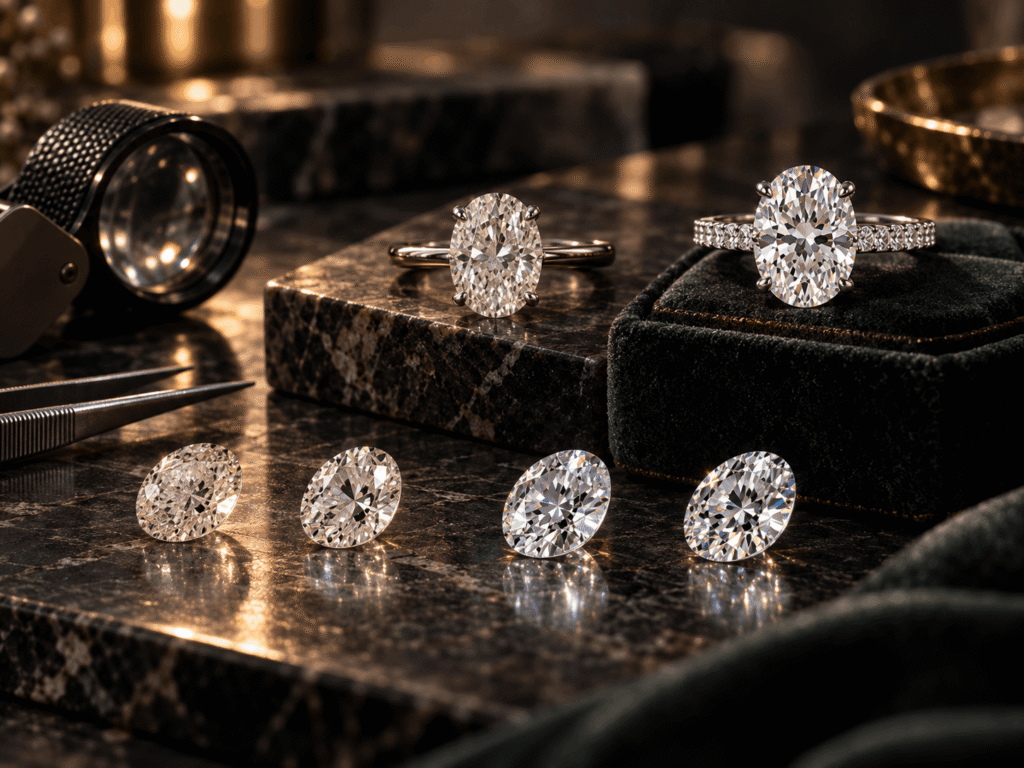
- Solitaire: Usually the least expensive, since there are no extra diamonds and the design uses less metal.
- Pavé: Costs more because you’re adding many small diamonds along the band.
- Hidden halo: Adds to the price with extra diamonds tucked beneath the center stone.
- Halo: The extra diamonds around the center add both stone and setting costs.
- Three-stone: Adds two larger side diamonds, which can make the ring considerably more expensive.
So when you see a 2 carat solitaire beside a 2 carat three-stone ring, the carat weight of the center may be identical while the rest of the ring is not.
Does The Metal Make A Noticeable Difference To The Price?
It can. A ring made in 14K gold is not the same product as the same design made in 18K gold or platinum.
Band width and the setting’s overall construction can change that amount too. A slim solitaire and a wider, more detailed ring may use very different quantities of metal even when both hold the same 2 carat center diamond.
This is one of those details that gets lost when you compare rings from thumbnail images. If the prices differ, check the metal listed for each ring before assuming the diamond is the reason.
If One 2-Carat Ring Is Cheaper, Is It Actually The Better Deal?
A cheaper ring can be a better buy, but only if you’re comparing similar rings. Before choosing one, check:
- Start with the center diamond. Look at its carat weight, shape, color, clarity, proportions, and grading. Two 2-carat diamonds can still be quite different.
- Check what “2 carat” means. It could be the weight of the center stone, or the combined weight of every diamond in the ring.
- Look at the setting. A simple solitaire won’t cost the same as a halo, pavé, or three-stone design because they use different amounts of metal, diamonds, and work.
- Then check the metal. 14K gold, 18K gold, and platinum can all change the final price.
- Look at what you’re actually getting for the listed price. Make sure it covers the full ring, not just the loose diamond.
- Check the diamond report too. Independent grading gives you useful details about the center stone you’re paying for.
- Finally, look at the buying terms. Returns, resizing, shipping, and warranty can make a difference once you actually place the order.
The lower price only tells you which ring costs less. The details tell you what you’re getting for that money.
When Is Paying More Actually Worth It?
Say you have two rings open in different tabs, and there’s a $500 or $1,000 difference between them. Before choosing the cheaper one, look at what that extra money changes for you.
Maybe you prefer the way one diamond looks. Its proportions give you the look you want. You may want pavé on the band rather than a plain solitaire, or you have already decided on a particular metal. Those are differences you can connect to the finished ring.
The price difference is harder to justify when you can’t find a clear reason for it. A higher grade can matter, but a higher letter or number on a report doesn’t automatically mean the diamond will look better to you.
Frequently Asked Questions
Is a 2 carat diamond ring the same as a 2 carat center diamond?
Not always. A 2-carat center diamond means the main stone weighs 2 carats. If it says 2 carats total weight, the smaller diamonds are included too. Always check what the listing means before comparing prices.
Why do two 2 carat lab-grown diamond rings have different prices?
Because the diamonds and the rings can be different. Shape, color, clarity, metal, setting, and extra diamonds can all change the price.
Is a 2 carat solitaire usually less expensive than a pavé or halo ring?
Usually, yes. A solitaire has a simpler design and no extra diamonds, while pavé and halo rings add more stones and setting work.
Should I compare the loose diamond price or the complete ring price?
If you’re buying a ring, compare the complete ring price. The loose diamond is only one part of the cost. The setting, metal, and any extra diamonds add to the final price.
Find Your 2-Carat Ring With Candor
Choosing a 2-carat ring gets easier when you can view the diamond and setting together.
Candor works with both parts of the finished ring. We cut and polish diamonds in-house, and we also make our jewelry settings in-house. So you can compare 2-carat lab-grown diamonds and finished rings in different shapes, settings, and styles to find an option that fits your preferences and budget.
If you’ve narrowed down your options but still have questions, talk to a Candor gemologist before you buy.
Explore the Candor collection.